Showing posts with label habits. Show all posts

Tuesday, February 23, 2021

Try Something Different


Writer Douglas Adams said, "Human beings, who are almost unique in having the ability to learn from the experience of others, are also remarkable for their apparent disinclination to do so." I sometimes wonder about my own disinclination to learn from experience. If you’re like me, you may repeat an unpleasant experience a few times before figuring out that something needs to change.

Maybe you can relate to a couple of men who were avid moose hunters. Every year they chartered a plane to take them to the Canadian backcountry. This year hunting was especially good and in a few days they each bagged a moose. They radioed for their pilot to come pick them up.

When the plane arrived, the pilot took one look at the animals and told the hunters they could not take such a heavy load along. 

“But we spent all week hunting,” they protested. “And besides, the pilot we hired last year wasn’t worried about the moose’s weight.”

After much argument, the pilot finally relented and allowed them to load the animals. The heavy plane was only airborne for a few minutes when it lost altitude and crashed into the side of a mountain. As the men struggled out of the wreckage, one hunter asked, “Where are we?” 

His friend answered, “About a mile farther than we got last year.” 

You’ve heard it said: Keep doing the same thing and you will keep getting the same results. Or repeating the same experiences.

What is not working well for you? A habit you are trying to break? A relationship with a parent or spouse or child or friend? 

What is a source of on-going frustration? Getting around to that project you keep promising to complete? Running up against the same old walls at work? 

And the big question: What needs to change?

If you don’t like the way things are turning out, what are you willing to try differently? And what if you tried it today?

-- Steve Goodier

Image: clip-library.com


Friday, January 8, 2021

Worry – The Real Enemy


What does it mean to worry? The Latin concept of worry describes a turbulent force within a person. Worry is a heart and mind in turmoil.

The ancient Greeks thought of worry as something that tears a person in two and drags that person in opposite directions. It is like opposing forces in deadly conflict within the very being of the individual.

The word “worry” itself comes from an old Anglo-Saxon term meaning to choke, or strangle, and that is exactly what it does – it chokes the joy of living right out of its victim. And it chokes off the energy to improve one’s condition.

There is a place for healthy concern, but too often our concern turns into fearful worry. And worry, more than the problem, becomes our real enemy.

Some people have worried for so long that they have become good at it. Just as we can become good at any attitude or behavior if we practice it enough, we can also become good at worrying. Worry is habit – a habitual response to life’s problems.

I rather like the attitude of the late United Methodist Bishop Welch. When he reached the age of 101, he was asked if he didn’t think a lot about dying. With a twinkle in his eye, he replied, “Not at all! When was the last time you heard of a Methodist bishop dying at 101?” Maybe one reason for his longevity is that he never developed the debilitating habit of worry.

I wish I could be like a frog, you know, just eat what bugs me. I’m not a frog, but I can still do the next best thing: I can develop a better habit. Instead of reacting to problems with fearful worry, I can practice coming from a place of peace and confidence. In other words, I can develop a habit of practicing calmness in turmoil.

As Harvey Mackey has said, “Good habits are as addictive as bad habits and a lot more rewarding.” And more fun to practice, I might add.

In this case, practice may not make perfect, but I’m sure to be immensely better off.

-- Steve Goodier

image: flickr.com/Kristian Dela Cour

Friday, October 30, 2020

A Simple Habit That Can Change Everything


Do you remember the story of the sailor who over-imbibed and fell asleep at his table? His buddies smeared a bit of strong smelling cheese dip on his mustache, which caused him to wake up and look around. He sniffed and then walked outside, sniffed again and came back in, walked out and back in one more time and finally sat down in his seat. “It’s no use,” he said to his friend, “the whole world stinks.”

Ever felt that way? We have all experienced bad days and horrible situations. We’ve felt trapped, helpless and, at times, hopeless. And sometimes it seems that the whole world stinks.

But I heard of one woman who learned never to view things that way. She grew up in extreme poverty and had every reason to think that her world, at least, stinks. But as a girl, she was privileged to be in a Sunday School class taught by a young woman named Alice Freeman. Freeman was later to become president of Wellesley College at age 26. (As an aside, she would later marry and become known as Alice Freeman Palmer, a renown advocate for education for women.) But let me continue with the little girl’s story.

One Sunday, Freeman asked the children to find something beautiful in their homes, and then tell the other children about it the next week. The following Sunday, when the little girl was asked what she found that was beautiful at home, she thought of her impoverished condition and replied, “Nothing. There’s nothing beautiful where I live, except...except the sunshine on our baby’s curls.”

Years later, long after Alice Freeman Palmer’s untimely death, her husband George was lecturing at a university in the western United States. He was approached by a distinguished looking woman who fondly recalled that, as a child, she attended his wife’s Sunday School class. Then she related this story:

“I can remember that your wife once asked us to find something beautiful in our homes, and that I came back saying the only beautiful thing I could find was the sunshine on my sister’s curls. But that assignment your wife made was the turning point in my life. I began to look for something beautiful wherever I was, and I’ve been doing it ever since.” 

That one simple act, repeated every day, became a powerful means of lifelong transformation for that woman.

If you have been thinking your “whole world stinks,” the daily habit of looking for something beautiful can help you see the good that actually exists wherever you are. You’ll see beauty that others miss. And you’ll never view your life the same again. 

It’s a simple habit that can change everything.

-- Steve Goodier

Image: flickr.com/zehhhra

Friday, November 9, 2018

The Push You Need


Behavioral experts teach that we are motivated both by pain and by pleasure. We can change behaviors and attitudes as we utilize the Principle of Pain and Pleasure.

Here is how it works: One of the most successful American football coaches was Vince Lombardi. But he was not an easy coach to play for. One player, Henry Jordan, chuckled about Lombardi, “He treats us all the same – like dogs.” He went on to say, “I play for the love of the game, the love of the money and the fear of Lombardi.”

When he plays for the love of the game and the love of the money, he is motivated by pleasure. He thinks of the enjoyment he will get when he is on the field and his financial success as a professional player. He may even think of the personal recognition he receives as a professional player and the feelings of self-respect he experiences as he continues to succeed. The pleasure of these thoughts motivates him to play well.

When he thinks of Lombardi’s ire if he does less than his best, he is motivated by pain. Fear is emotional pain – as real as any physical pain. He may think also of the pain of losing his position to another player or even of the embarrassment of a fumbled ball. People will go to great lengths to avoid pain, in whatever form they find it.

All of these “pain thoughts,” as well as his “pleasure thoughts,” help him to rise to his best level of performance. This is the Principle of Pain and Pleasure.

What do you need motivation to do? Is it something related to your job or school? A project? A time-consuming task you’ve been putting off?  Do you need motivation to do something personal, such as quitting a crippling habit? Or do you need more encouragement to work on a huge lifestyle change?

Utilize the Principle of Pain and Pleasure. Think of the pain you will eventually feel (or even feel now) as you fail to follow your heart’s lead. Be creative. Close your eyes and visualize how that pain is oppressing you. Try to see in gory detail how the pain of failing at what you want to accomplish is going to hurt. Spend a little time just feeling that pain.

Then think of the pleasure you will experience as you do or become whatever it is you want for yourself. Visualize yourself as free and happy as you can imagine being. Try to see in your mind’s eye how your eventual success will elevate your life to whole new levels. Spend time feeling that pleasure.

This simple technique will help  you will find the push you need to give birth to your beautiful new life.

-- Steve Goodier 

Image: FreeImages.com/Fernando AUDIBERT

Friday, January 6, 2017

Ready to Grow a Little?


"The trouble with resisting temptation," says one woman, "is that it may never come again." Hmmm....

Mark Twain noted that “there are several good precautions against temptation, but the surest is cowardice.” And poet W. B. Yeats said this about those ever-present allurements: "My temptation is quiet." It’s true. They so often sneak up on us unawares.

Oscar Wilde quipped, "I can resist everything except temptation." Isn't that the way it is for most of us? 

Many folks pray, "Lead us not unto temptation." But the problem is ... we honestly don't need leading -- we can find the way there ourselves. And even enjoy the journey. 

It is not always possible to avoid that which is not in our best interest. We're enticed to spend money we don't have. We're lured to ingest something that we will later regret. We're pulled toward people who may not be good for us, and tempted to get back at those who've used or hurt us. Seductions of various kinds bait us at every opportunity.

One pet store owner learned a hard lesson about temptation. He bought a one-foot, three-pound grouper to add to his large saltwater aquarium. He knew that groupers tend to eat smaller fish, but he thought he could control what the fish ate by hand feeding it. In time, however, he noticed that the expensive, exotic fish in his tank had grown sparse.

After 18 months, he was out $5,000 worth of tropical fish. But he now had a three-and-a-half foot long, 35 pound grouper. And who can blame the culprit? Lots of us can’t resist fresh sea food!

But you and I aren't fish. We CAN do something about those temptations that assault us daily. And it’s not just about temptation. 

Maybe you want to change an attitude (control your anger?) or behave differently (eat healthier food?). Well, you can actually do something. You can make the decision, just this time, to act in your best interest, rather than on impulse. You can decide to come from a better place -- for just this moment. 

And that is all that usually matters: making the decision just once today. Just this time. We can always change a behavior or attitude just once. And there’s something powerful in doing it every day… even if it’s just once.

The fact is, you and I build fruitful and productive lives one little decision at a time. Every time we decide to act intentionally, we grow a little. 

Are you ready to grow a little today?

-- Steve Goodier

Friday, August 10, 2012

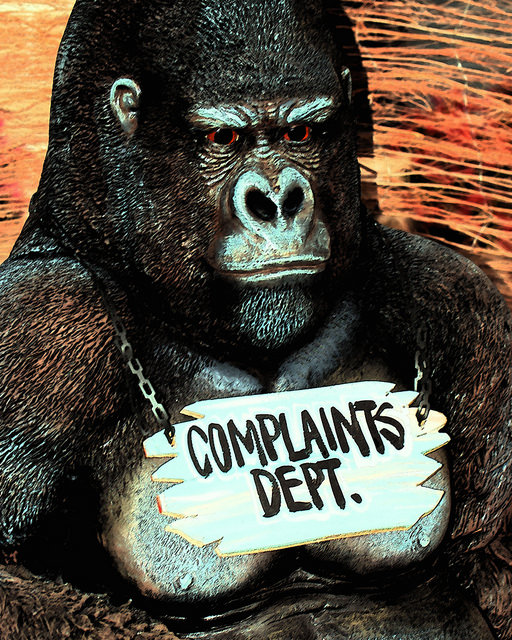
At the Complaint Counter


I understand that an Athens hotel posted a sign that read: “Visitors are expected to complain at the office between the hours of 9 a.m. and 11 a.m. daily.” So, visitors are actually expected to complain?

Of course, complaints in themselves are not bad things. I realize that something has to be addressed before it can be fixed, and I believe that there are times when dissatisfaction should be expressed. What’s more, I realize that we all have different temperaments. Some people naturally see the glass half full, some see it half empty and some just see that they will probably end up washing it. Some people are naturally more accepting while others complain quickly.

But a tendency to constantly look at what is wrong can become a habit. And habits can take over. I just don’t want to become a person who spends a lot of time “standing at the complaint counter.”

Like the woman who frequented a small antique shop. She complained constantly about the prices, the quality and even the location.

The shop owners took it in stride, but one day, while ranting about selection, she blasted the clerk with: “Why is it I never manage to get what I ask for in your shop?”

The clerk smiled and replied, “Possibly because we’re too polite.”

I find that if I fill my mind with the little irritants of life, I have no room, or energy, left for anything that nurtures and feeds my spirit. No room for genuine appreciation. No room for understanding. No room for enjoyment. No room for fond memories. No room for storing a list of things that bring pleasure.

I actually believe there is much to feel good about. Humorist Bob Orben rightly said, “The next time you feel like complaining, remember that your garbage disposal probably eats better than thirty percent of the people in this world.” I want to leave room in my mind for a long gratitude list that I can readily recall when I need a boost. I want to notice what’s good and right about the world. And I want to fill my heart and head with that which brings some joy so that I may go to bed each evening contented.

Attitudes are habits. Like television producer Barbara Gordon says, “While others may argue about whether the world ends with a bang or a whimper, I just want to make sure mine doesn’t end with a whine.” I can’t put it any better than that.

-- Steve Goodier

image: flickr.com/Leonard J Matthews

Friday, August 20, 2010

Paying Attention to Habits


There was a fire one night at a convent and several nuns who lived on the fourth floor were trapped. They were praying for divine providence to show them a way out of the fire when one of the sisters screamed, "We need to take off our robes, tie them together, and climb down to safety."

Later as they were recounting the event to reporters, they were asked if they were afraid that the crude rope might not hold up. "Oh, no," they said, "Old habits are hard to break."

Do you know the story of the touchstone? It tells of a fortunate man who was told that, if he should find the “touchstone,” its magical powers could give him anything he wanted. It could be found, he was informed, among the pebbles of a certain beach. All he need do is pick up a stone – if it feels warm to the touch, unlike the other pebbles, he has found the magical touchstone.

The man went immediately to the beach and began picking up stones. When he grasped a pebble that felt cold, he threw it into the sea. This practice he continued hour after hour, day after day, week after week. Each pebble felt cold. Each pebble was immediately tossed into the sea.

But then, late one morning, he happened to take hold of a pebble that felt warm, unlike the other stones. The man, whose consciousness had barely registered the difference, tossed it into the sea. He hadn’t meant to, but he had formed a habit, and habits can be hard to break.

Most of my habits are more like routines. I habitually arise about the same time every day – too early, it seems. I exercise. I fix oatmeal for breakfast. Most days I listen to the same kinds of music and even read the same kinds of literature. (I hope I don’t repeat the same old stories.) My routines include those places I like to visit and the people I like to see. It’s all fairly predictable. But what I call routine is more like a series of habits, some of which work well for me and some I should perhaps look at a bit more closely.

In fact, any behavior that I repeat, I reinforce. If I repeat it often enough, it becomes habit. Soon I don’t even think about it – old habits are hard to break. Even good ones.

A Spanish proverb says: “Habits are first cobwebs, then cables.” The metaphor works well for “bad” habits. They first entice, and then ensnare us like a cobweb. And if we continue in the behavior, the web grows stronger and can be as difficult to break as a steel cable.

But some habits can work in our favor. Such as patterns in the way we live our lives. Or positive attitudes and healthy ways of thinking. Our habitual attitudes and behaviors can either help us or hinder us.

The truth is this: we form our habits, then our habits form us. So we ought to pay attention to the habits we’re forming.

Is there a behavior or attitude you would like to make into a habit? Then reinforce it by repeating it at every opportunity. Is there a something you wish to change? Then substitute a different attitude or behavior and repeat the new one every chance you get.

When it comes to habits, practice may not make perfect. But practice will certainly make permanent. Your habits will form you. So form the habits you want and let them mold you into the person you want to be.

-- Steve Goodier

Image: flickr.com/Joanídea Sodret

Tuesday, May 12, 2009

Driving Out Bad Nails


A teacher who was lecturing on habits told his class, “Anything you repeat twenty times is yours forever.” From the back of the classroom came a whispered voice, “Sarah, Sarah, Sarah, Sarah....” Of course, what the teacher was trying to say is that any behavior, often repeated, becomes habit.

The Dutch scholar Desiderius Erasmus once said, “A nail is driven out by another nail. Habit is overcome by habit.” And if I understand him right, he suggests that saying no to a bad habit is not enough. Instead, we should try to replace it with a good one. Repeat the new behavior twenty time ... and it is yours.

If any behavior, good or bad, is often repeated, it becomes stronger and more powerful. “Since habits become power, make them work for you and not against you,” said E. Stanley Jones. In other words, drive out the undesirable nail, the behavior you’d like to change, with a better one.

One woman did just that after lamenting to her friend, “I hate being late. It has been a problem for me all of my life.”

“Do you really want to change that habit?” her friend asked. The woman said that she did and her friend responded, “All right. Every time you’re late for work or anywhere else, then give me $25.”

“I’d go broke!” she said. “But I’ll do $10.”

“It’s got to hurt,” said the friend.

“Believe me, that will hurt,” the woman replied. They agreed that the money should be deposited in a jar and used for charity.

In the first week, the habitually tardy woman made a concerted effort to plan ahead and she only paid $10 to her friend. The next week, $20. The third week, none at all. By week five, she had built a strong habit of leaving early, and her new behavior replaced the old pattern of tardiness that had hindered her for so long. She drove out one nail with another one. And she found freedom.

If you’re like me, there is a bad nail you want to remove. Today is a good day to pick up a better nail and start using it.

-- Steve Goodier

Image: flickr.com/Wayne Stadler